SAP Sapphire 2026
SAP Just Redefined What an
ERP Company Looks Like
Insights from the TSP Team at SAPPHIRE 2026
We were on the ground at SAP SAPPHIRE 2026 in Orlando, and the energy here was unlike anything we’ve seen in recent years. The keynote didn’t just announce new products — it announced a new identity for SAP.
Here’s our unfiltered read on what was announced, what it means, and what SAP customers should be thinking about right now.
SAP CEO Christian Klein opened the keynote with a deliberately provocative question: “Will SAP be a software company in the future?” By the end, SAP’s own AI assistant Joule answered it: SAP is becoming a business AI company.
The centerpiece of this shift is the Autonomous Enterprise — a three-part architecture that represents a full re-platforming of how enterprise software is built, deployed, and used. Let’s break down what each piece actually means.
The unified governed foundation bringing BTP, Business Data Cloud, and Business AI together in one environment
50+ domain-specific Joule Assistants and 200+ specialized agents across every major business function
A reimagined engagement layer where users describe outcomes in natural language and Joule orchestrates everything
The most striking UX shift announced at SAPPHIRE is Joule Work — a reimagined engagement layer where users no longer navigate menus, switch between applications, or manually enter data across screens. Instead, users describe a desired business outcome in natural language, and Joule orchestrates the workflows, data, and agents to get it done.
The LiveKit partnership adds intelligent real-time voice capabilities to Joule — meaning employees whose work happens away from a keyboard — on a factory floor, in a warehouse, in the field — can now access Joule conversationally for the first time.
The SAP Autonomous Suite is where the Autonomous Enterprise vision gets concrete — and the announcement is sweeping. SAP is deploying more than 50 domain-specific Joule Assistants across every major business function, each orchestrating a subset of over 200 specialized Joule Agents.
7 new Joule Assistants transforming the office of the CFO — Financial Closing, Planning, Billing, Governance, Tax & Compliance, Accounts Receivable, and Cash & Treasury. The Financial Closing Assistant alone automates posting, accruals, journal validation, intercompany reconciliation, and error resolution.
Autonomous Spend covers the entire source-to-pay lifecycle: Category Management, Sourcing, Supplier Management, Requisition, Invoicing, Receiving, and Services Procurement — addressing a historically major gap in SAP’s spend management story.
13 new Joule Assistants covering payroll, recruiting, onboarding, learning, compensation, time, and HR services — most planned for GA in June 2026. AI-enabled Workforce Planning connects SuccessFactors, Fieldglass, and Cloud ERP for unified employee and contingent labor planning.
Manufacturing, Planning, Logistics, Asset & Service, Product Design, and Business Network Assistants. The Manufacturing Assistant is a multi-agent system unifying people, operational goals, and processes for real-time production decisions.
Full customer lifecycle coverage: marketing (Campaign, Content), commerce (Merchandising, Shopping, Order Lifecycle), sales (Deal Qualification, Deal Closing), and service (Self-Service, Case Management). The Parloa partnership embeds voice AI agents directly into SAP Service Cloud.
SAP unified three previously separate pillars — SAP Business Technology Platform (BTP), SAP Business Data Cloud, and SAP Business AI — into a single governed environment: SAP Business AI Platform.
AI models trained on SAP-specific code, data, metadata, and business processes. Unlike generic LLMs, these models understand SAP architecture natively — enabling clean-core compliant code generation and natural-language data queries directly within SAP systems.
SAP’s new AI-first development environment for building agents, apps, extensions, and workflows. Supports LangGraph, AutoGen, LlamaIndex, and natively supports MCP and Agent2Agent (A2A) protocols for interoperability. Developers describe intent; Joule Studio generates code and scaffolding.
A vendor-agnostic command center to discover, inventory, govern, and evaluate AI agents across the enterprise. As agent deployments scale, governance becomes critical — the AI Agent Hub provides a single system of record for all AI assets regardless of origin.
Now with SAP HANA Cloud natively embedded, bringing vectors, graphs, relational, and spatial data together in one in-memory database. The planned acquisition of Reltio will further strengthen the data fabric, enabling master data unification across SAP and non-SAP systems.
SAP’s partner announcements at SAPPHIRE 2026 reinforce a deliberately open ecosystem strategy — bringing best-in-class capabilities from across the industry into the SAP platform.

Claude becomes a primary reasoning and agentic capability embedded across SAP’s AI portfolio, powering Joule agents across finance, HR, procurement, and supply chain.

AIP for data migration, complementing SAP’s own migration toolchain with AI-supported analysis, code remediation, and testing at scale — with Accenture as a co-innovation partner.

Joule Studio runtime embeds NVIDIA OpenShell for added security and enterprise governance of autonomous agents.

Zero-copy bi-directional integration with Amazon Athena; bidirectional agent-to-agent capabilities and expanded sovereign cloud offerings with Google and Microsoft.

Visual AI workflow orchestration embedded directly in Joule Studio (n8n); frontend development flexibility for SAP Commerce and custom experience layers (Vercel).
The Autonomous Enterprise is a compelling vision — but the path to realizing it is not automatic. Here’s what every SAP customer should be asking themselves right now.
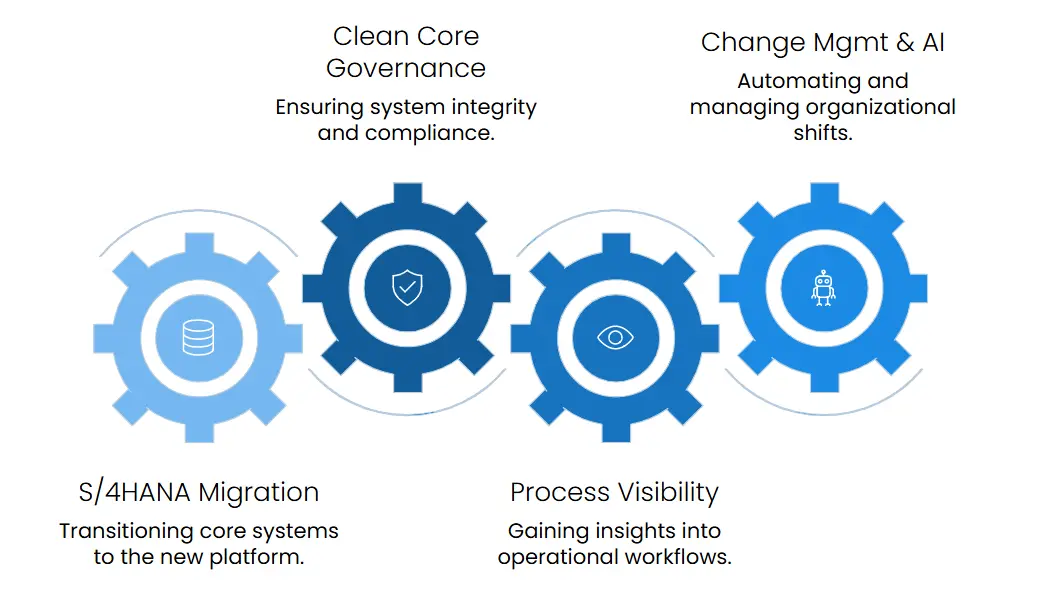
RISE with SAP customers will receive Joule Assistants activated within their first year. GROW customers get access to the full assistant portfolio at onboarding. ECC customers are being left behind — not gradually, but at an accelerating pace.
Every AI assistant and agent announced at SAPPHIRE requires clean data, governed processes, and a standardized system landscape. Customizations are liabilities. Clean Core is no longer a best practice — it’s the prerequisite for AI.
You can’t transform what you can’t see. Kelvin’s process heatmap capability, combined with SAP Signavio and TSP’s pre-migration assessment framework, is exactly the kind of visibility that determines transformation success.
Joule Work fundamentally changes how people interact with SAP software. The user adoption challenge is real — and it needs to be planned for from Day 1, not bolted on at go-live.
Organizations that address all four dimensions will be positioned to activate the Autonomous Suite at speed. Those that skip steps will find the AI promise out of reach.
SAP has laid out a clear and ambitious roadmap. The Autonomous Enterprise isn’t a 2030 vision — the first wave of Joule Assistants hits general availability in Q2 and Q3 2026. The organizations that will capture disproportionate value from these innovations are the ones that are ready for them: clean core in place, S/4HANA migration complete, process landscape understood.