ROBOTS vs AGENTS:
Who wins the Automation Olympics?
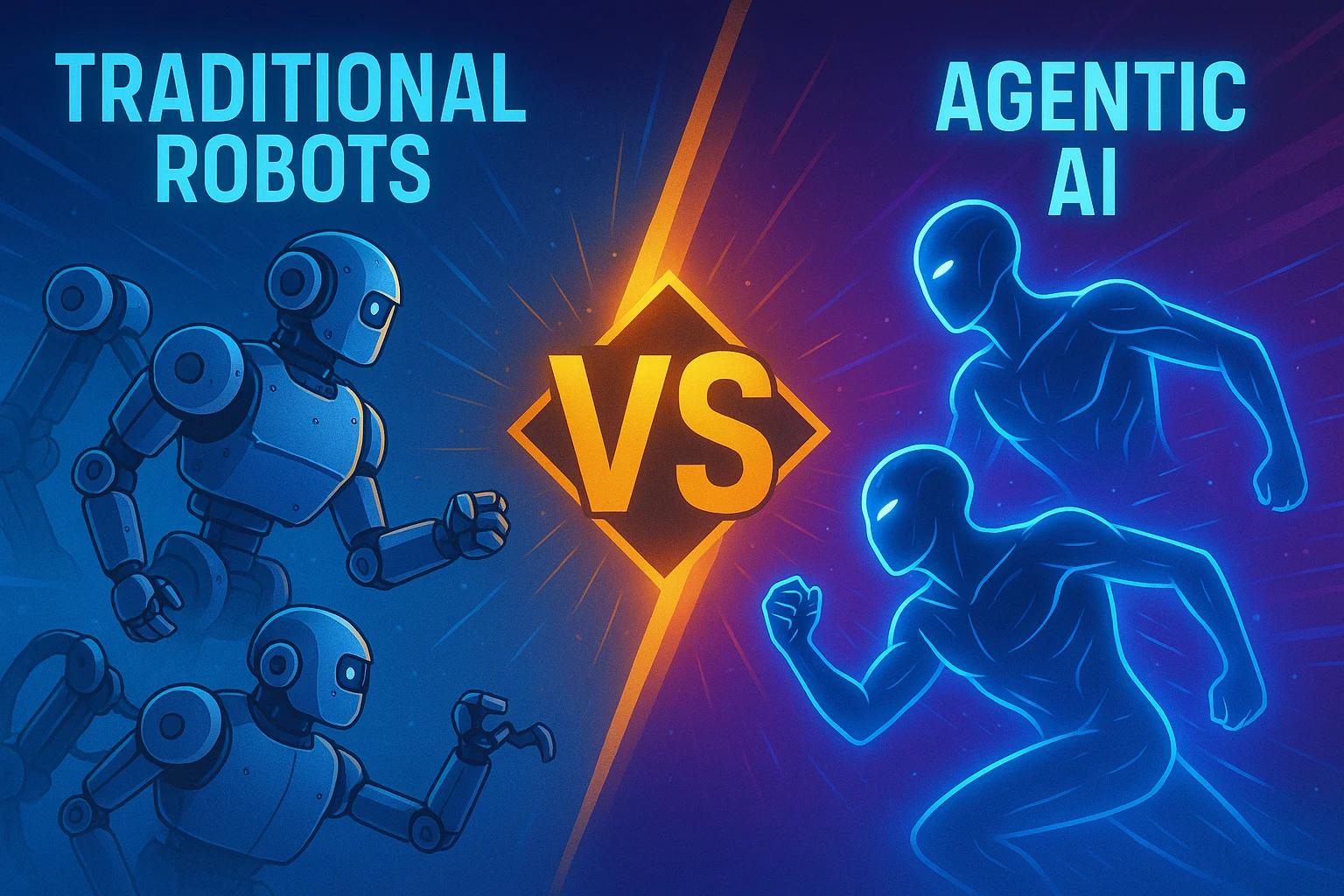
Automation is evolving fast and with it, a new kind of contest is emerging. On one side, we have traditional robots: rule-based, efficient, but rigid. On the other, a rising force, Agentic AI that thinks, adapts, executes and learns on the go.
As companies push to streamline operations, cut costs, and stay ahead, it’s crucial to understand what each of these technologies brings to the table.
Let’s put them through a series of real-world automation challenges to explore how Agentic AI’s autonomy, memory, and flexibility are beginning to outshine the old-school approach. It’s not just a tech comparison. It’s a glimpse into the future of work.
Robotic Process Automation: The Industrial Workhorse
Traditional robots are engineered to perform repetitive, rule-based tasks with high precision and consistency. They are widely used across sectors like manufacturing, automotive, electronics, food and beverage, and pharmaceuticals, where structured processes dominate.
But there are limitations to this mode as well. With traditional robots, there is a perpetual risk of rigid programming limiting the flexibility. The need of reprogramming is required for new tasks. There is also a lack of learning and adaptation capabilities as the scope of modification is limited with traditional robots. Another important point is that they operate best in deterministic, predictable settings.
Agentic AI: The Autonomous Innovators
Agentic AI represents the next evolution in intelligent systems those which are capable of making autonomous decisions, learning continuously, and adapting to new situations without constant human input.
Unlike traditional automation, which relies on static rules, Agentic AI systems leverage advanced technologies such as machine learning, natural language processing, and cognitive computing to function effectively in dynamic, less predictable environments.
What sets Agentic AI apart?
It is its ability to operate with true autonomy and initiate tasks, making context-aware decisions, and adjusting strategies in real time. These systems continuously improve through reinforcement and few-shot learning techniques, becoming smarter with each interaction.
It is transforming how businesses handle data operations and automation, freeing up human talent for more strategic, value-driven work.
Automation Challenges: Robots vs. Agentic AI Agents
When it comes to automation, the capabilities of traditional robots and Agentic AI diverge significantly, particularly in how they approach autonomy, learning, adaptability, collaboration, and scalability.
- Features
- Autonomy
- Learning Capability
- Adaptability
- Ideal Use Cases
- Agentic AI Agents
- Context-aware, autonomous
- Continuous
- High
- Complex, unpredictable environments
- Traditional Robots
- Rule-based
- None (manual updates)
- Low (Rigid)
- Structured, predictable environments
Across these dimensions, Agentic AI clearly leads the next phase of automation, offering the intelligence, flexibility, and scale that modern enterprises need to stay competitive.
The Big Question: Who Wins the Automation Olympics?
While traditional automation has been the backbone of automation for decades, excelling in precision and repetitive task execution, Agentic AI agents are redefining the future of automation with their autonomy, memory, adaptability, and collaborative intelligence.
According to the World Economic Forum, over 50% of employers plan to accelerate automation of some tasks, with over 80% speeding up digitization efforts, underscoring the urgency for more autonomous systems.
In the “Automation Olympics,” Agentic AI agents emerge as the champions for next-generation automation challenges, offering scalable, intelligent, and autonomous solutions that outpace the capabilities of traditional robots.
At TSP, the future isn’t just automated. It’s Agentic.
Discover how Agentic AI is revolutionizing the enterprise landscape with practical use cases that highlight significant ROI and operational efficiencies in the following webinar with TSP and UiPath experts